
MB to DTFR Specifications Explained: A Complete Guide to Mercedes-Benz Truck Engine and Gear Oils
Published by Hamid Shakouri on 8th Nov 2026
Introduction
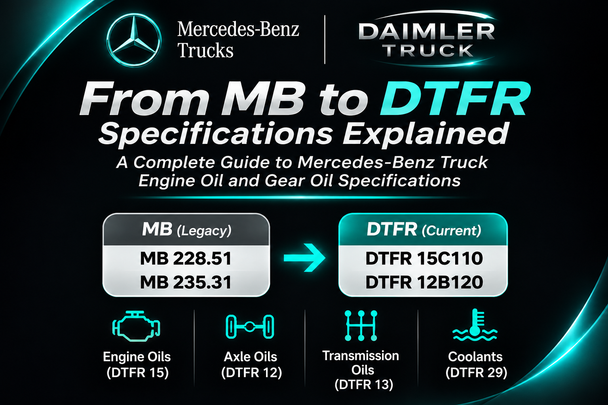
If you run or service Mercedes-Benz trucks, you have probably noticed new codes on oil labels and product data sheets. Where you once looked for MB 228.51 on an engine oil or MB 235.31 on an axle oil, you now see DTFR 15C110 and DTFR 12B120. The owner’s manual says one thing, the drum says another, and nobody wants to guess when an engine, gearbox or differential is at stake
What do these changes mean, and how can you make sure you are using the correct oil for your vehicle?
This guide explains the transition from MB to DTFR specifications, compares engine and gear oil codes, and outlines how to verify the correct lubricant for your truck. Whether you manage a transport fleet, operate a workshop or purchase lubricants for heavy-duty vehicles, understanding these specifications will help you make informed maintenance decisions.
1. What are OEM lubricant specifications?
Lubricants are classified using industry standards and vehicle manufacturer specifications.
Industry standards
- API: categories such as CK-4 and FA-4 for heavy-duty diesel engine oils, and GL-4 and GL-5 for gear oils.
- ACEA: European lubricant performance sequences, including categories for heavy-duty diesel engines.
- SAE: viscosity classifications such as SAE 10W-40 and SAE 5W-30.
These standards describe lubricant performance and viscosity. However, they do not on their own establish that an oil is suitable for a particular engine, gearbox or axle.
Original Equipment Manufacturer (OEM) specifications
Vehicle manufacturers set additional requirements to match lubricants to their engines and driveline components. For Mercedes-Benz trucks, these requirements are published in the manufacturer’s operating-fluid specifications. Other heavy-duty vehicle manufacturers and component suppliers, including MAN, Volvo, Scania and ZF, publish their own requirements too.
Important: an oil with the correct viscosity grade is not necessarily suitable for your vehicle. Always check the required OEM specification as well as the viscosity grade.
Approved versus “meets”
Lubricant product data sheets may use terms such as:
- Officially approved: the product holds the manufacturer’s approval and appears on the manufacturer’s approval list.
- Meets the requirements, or suitable for: the supplier makes a performance claim, but this wording alone does not establish formal OEM approval.
If a vehicle manufacturer, warranty condition or fleet contract requires an official approval, verify that approval in the manufacturer’s database.
2. Why did Mercedes-Benz truck oil specifications change?
Following the separation of Daimler into independent businesses, Daimler Truck introduced its own specification system for commercial vehicles: DTFR, which stands for Daimler Truck Fluid Release. The system separates operating fluids into families, including engine oils, axle oils, transmission oils and coolants.
For the specifications that were carried over, the technical requirements did not change. Daimler Truck renamed the sheets, and products approved under the old MB sheets were transferred to the matching DTFR lists. For example:
- MB 228.51 corresponds to DTFR 15C110.
- MB 228.31 corresponds to DTFR 15C100.
- MB 235.31 corresponds to DTFR 12B120.
The official Mercedes-Benz Trucks operating-fluids database publishes the current specifications and lists the products approved against each one:
Mercedes-Benz Trucks Operating Fluids – Official Approval Database
Trucks only, not cars
DTFR applies to Daimler Truck commercial vehicles. Mercedes-Benz passenger cars and vans such as the Sprinter continue to use MB-Approval 229.x engine oil specifications. If someone tells you that your car needs a DTFR oil, two separate systems have been mixed up.
Keep one more point in mind: a renamed sheet carries the same requirements as its predecessor, but different sheets are not interchangeable with one another. A newer or higher DTFR number is not an upgrade on an older one.
3. How to read a DTFR specification
The first two digits of a DTFR code identify the fluid family. The letter and the final digits identify the individual specification sheet within that family.
| DTFR family | General application |
|---|---|
| DTFR 10 | E-drive fluids |
| DTFR 12 | Axle oils |
| DTFR 13 | Transmission and gear oils |
| DTFR 15 | Engine oils |
| DTFR 29 | Coolants |
| DTFR 38 | Steering gear oils |
The letter after the family number is defined separately within each family. In engine oils, C sheets cover low-SAPS oils. In transmission oils, C sheets cover automatic transmission fluids and D sheets cover retarder oils. For example:
- DTFR 15C110 identifies a low-SAPS heavy-duty engine oil specification.
- DTFR 12B120 identifies a hypoid gear oil specification for commercial vehicle axles.
- DTFR 13B100 covers gear oils for steering and manual transmission applications.
Always consult the applicable specification sheet and vehicle documentation before selecting a product.
4. Mercedes-Benz truck engine oil specifications: MB 228.x to DTFR 15
The following table shows how the previous MB engine oil specifications correspond to their DTFR replacements.
| Previous MB specification | Corresponding DTFR specification |
|---|---|
| MB 228.3 | DTFR 15B110 |
| MB 228.5 | DTFR 15B120 |
| MB 228.31 | DTFR 15C100 |
| MB 228.51 | DTFR 15C110 |
| MB 228.52 | DTFR 15C120 |
| MB 228.61 | DTFR 15C130 |
| MB 228.71 | DTFR 15C140 |
Source: Official Mercedes-Benz Trucks DTFR overview (status 08/2026).
These correspondences are useful when comparing older product labels with current technical documentation. The correct choice still depends on the engine, model year, operating conditions and the manufacturer’s specified oil requirements.
What does DTFR 15C110 mean?
DTFR 15C110 is the new name for the former MB 228.51 engine oil specification, with the same technical requirements. It covers low-SAPS heavy-duty engine oils, which are formulated to help protect exhaust after-treatment systems such as diesel particulate filters (DPFs).
When selecting an engine oil for a truck that requires this specification, check both the viscosity grade and the product’s approval status.
Important: DTFR 15C140 is not a universal upgrade
A newer specification number does not automatically mean that the oil is suitable for every older engine.
DTFR 15C140, formerly MB 228.71, is not backward compatible with earlier Daimler Truck engine oil specifications. Its low high-temperature high-shear (HTHS) viscosity of around 2.6 mPa·s suits engines designed for it, such as the OM471 HDEP 2020 engine built after June 2022. An engine designed for a thicker oil film relies on that film for bearing and wear protection.
Use DTFR 15C140 only when the manufacturer’s documentation specifies it for the relevant engine. Never choose an engine oil just because its specification number looks newer.
5. Axle gear oils: MB 235.x to DTFR 12
Axle oils lubricate differential gears, bearings and other components that operate under heavy loads. The DTFR system has a dedicated family for commercial vehicle axle oils.
| Previous MB specification | Corresponding DTFR specification |
|---|---|
| MB 235.0 | DTFR 12B100 |
| MB 235.20 | DTFR 12B110 |
| MB 235.31 | DTFR 12B120 |
| MB 235.6 | DTFR 12B130 |
| MB 235.8 | DTFR 12B140 |
The DTFR list also includes axle sheets that never had an MB predecessor, such as DTFR 12C100 and DTFR 12C110 for Meritor axles fitted to the Actros C.
These specifications cover different applications and requirements. Do not treat them as a ranking in which a higher number automatically replaces a lower one.
How do you choose the right axle oil?
- Check the truck’s owner’s manual and the axle identification plate.
- Identify the exact DTFR specification required, or its corresponding MB specification.
- Confirm the viscosity grade specified by the manufacturer.
- Check the product’s technical data sheet and official approval status.
- Follow the prescribed service interval for your operating conditions.
A lubricant approved for one axle may not be suitable for another axle fitted to the same vehicle.
6. Manual transmission oils: DTFR 13B
Manual transmissions and transfer cases need lubricants designed for their particular gears, bearings and synchroniser systems. The DTFR 13 family separates several transmission and gear oil applications.
| Previous MB specification | Corresponding DTFR specification |
|---|---|
| MB 235.1 | DTFR 13B100 |
| MB 235.11 | DTFR 13B110 |
| MB 235.12 | DTFR 13B120 |
| MB 235.16 | DTFR 13B140 |
| MB 235.4 | DTFR 13B150 |
| MB 235.41 | DTFR 13B160 |
| MB 235.5 | DTFR 13B170 |
Use these correspondences as a reference, then verify the specific requirement against the current official documentation for your transmission.
Can you use an axle oil in a manual gearbox?
Not necessarily. Some manual gearboxes need lubricants with specific friction characteristics and synchroniser compatibility. A hypoid axle oil that performs well in a differential may not suit a synchronised manual transmission.
API GL-4 and GL-5 classifications alone do not establish suitability for every gearbox. Always select a product that meets the specification required for your transmission.
7. Automatic transmission fluids: DTFR 13C
Automatic transmission fluids (ATFs) need carefully controlled friction characteristics, viscosity and material compatibility. In the DTFR system, they sit in the 13C group.
Most of the older MB 236.x ATF sheets are now listed as historical. The current sheets are:
| Previous MB specification | Corresponding DTFR specification | Application |
|---|---|---|
| MB 236.9 | DTFR 13C170 | Allison and automatic transmissions |
| MB 236.91 | DTFR 13C180 | Allison transmissions and retarders |
| MB 236.92 | DTFR 13C190 | Allison transmissions and retarders |
An ATF approved for one transmission should not automatically be used in another, even when the two fluids look similar in colour or viscosity. Before selecting an ATF, confirm:
- the transmission model and identification
- the required manufacturer’s fluid specification
- the product’s approval for that specification
- the required service procedure and fluid level-checking method.
Using an unsuitable transmission fluid can affect shifting performance and may contribute to component damage.
8. Lubricants for electric trucks
Electric commercial vehicles can have different lubrication requirements from conventional diesel trucks. Depending on the design, e-drive systems may need fluids that combine gear protection, heat transfer and compatibility with electrical components.
The DTFR 10 family covers electric-drive applications. The current list includes separate sheets for e-axle motor-circuit fluids, ZF CeTrax2 drive systems, and electric motor oils and axle gear oils for battery-electric trucks.
These fluids are not interchangeable with conventional axle oils, manual transmission oils or automatic transmission fluids. Always consult the manufacturer’s documentation for the particular electric axle or drive system.
9. Practical checklist for workshops and fleet managers
- Identify the vehicle and component. Confirm the model, engine, axle or transmission that needs lubrication.
- Check the manufacturer’s documentation. Use the owner’s manual, service documentation and component identification plates to find the required specification.
- Verify the oil specification. Compare the required specification with the product data sheet. Do not rely on viscosity grade alone.
- Confirm official approval. Check the Mercedes-Benz Trucks Operating Fluids database for the product and specification. Approvals are time-limited, so check the current listing rather than an old data sheet.
- Check the service requirements. Confirm the viscosity grade, operating conditions and prescribed oil change interval.
- Keep purchasing records up to date. Record both the legacy MB specification and its DTFR code, for example “MB 228.51 / DTFR 15C110”, so purchasing teams and workshop staff can identify the correct product.
10. Frequently asked questions
Is DTFR 15C110 the same as MB 228.51?
Yes. Daimler Truck renamed the sheet without changing its technical requirements, and products approved under MB 228.51 were transferred to the DTFR 15C110 list. As always, check that the specific product’s approval is current.
Is DTFR 12B120 the same as MB 235.31?
Yes. It is the same hypoid axle oil specification for commercial vehicles, renumbered under the DTFR axle-oil family.
Can I use an oil that only lists the old MB specification?
If the product held the MB approval, that approval was transferred to the matching DTFR list. Labels and data sheets are being updated gradually, so older stock may still show only the MB number. Confirm the product’s current approval in the official database.
Does my Mercedes-Benz car need a DTFR oil?
No. DTFR applies to Daimler Truck commercial vehicles. Mercedes-Benz passenger cars and vans such as the Sprinter continue to use MB-Approval 229.x engine oil specifications.
Does a higher DTFR number mean better performance?
No. Different specification numbers represent different applications and requirements. The correct specification is the one required for your engine or component.
Can I use the same oil in the engine, gearbox and differential?
Not unless the product meets the requirements for each application. Engine oils, axle oils, manual transmission oils and ATFs are designed for different operating conditions.
Where can I check official Mercedes-Benz truck oil approvals?
Use the Mercedes-Benz Trucks Operating Fluids database to check the specification and the approved products.
Conclusion: choose the correct oil for your truck
The move from MB to DTFR specifications has changed how many Mercedes-Benz truck lubricants are identified. For the specifications that were carried over, the requirements are the same and only the name has changed. Knowing the corresponding codes makes it easier to read product labels, compare technical data sheets and keep purchasing records accurate.
Selecting the correct lubricant still takes more than matching numbers. The oil must suit the particular engine, axle or transmission, and hold the approval the manufacturer requires.
Need help choosing the right lubricant for your truck or fleet? Explore the lubricants available at Oila, or contact our team to find a product that matches your vehicle’s requirements.