
Industrial Gear Lubricants: Types, History, and Formulation Differences
Published by Hamid Shakouri on 2nd Aug 2026
Industrial Gear Lubricants: Types, History, and Formulation Differences
A Practical Guide to Selection, Chemistry, and Industry Standards
Introduction
Industrial gear lubricants are critical components in modern machinery, protecting heavily loaded gears from friction, wear, overheating, and premature failure. From mining equipment and cement mills to wind turbines and manufacturing gearboxes, the correct lubricant selection directly affects reliability, energy efficiency, and maintenance costs.
Gears are among the oldest mechanical devices used to transmit power, and wherever metal teeth mesh under load, friction and heat follow. Over the past century, the chemistry behind the protective lubricant film has evolved from simple animal fats to precisely engineered synthetic molecules — a story that closely tracks the industrialization of heavy machinery itself.
1. A Brief History of Gear Lubrication
Early mechanical lubrication (pre-1900s)
Before refined petroleum was widely available, gear and machinery lubrication relied on animal and vegetable oils — tallow, lard oil, whale oil, and castor oil. These provided reasonable “oiliness” (boundary lubrication) but oxidized quickly, gummed up, and offered no protection against the extreme pressures generated by heavily loaded gear teeth.
The petroleum era begins (1900s–1930s)
With the growth of the petroleum refining industry, mineral oils became the dominant base stock for industrial lubricants. Early gear oils were essentially straight mineral oils with no additives. They worked reasonably well for lightly loaded, low-speed gearing but failed under the higher loads and speeds demanded by expanding industrial and automotive applications, leading to scuffing, pitting, and premature gear failure.
The additive revolution (1930s–1950s)
The single biggest turning point in gear lubricant history was the development of extreme pressure (EP) additives, particularly sulfur-phosphorus chemistry. These additives react with the metal surface under high localized pressure and temperature to form a sacrificial protective film, preventing welding and scoring of gear teeth even under boundary lubrication conditions. This innovation contributed to the development of automotive API GL classifications and influenced the evolution of industrial EP gear lubricant categories, including AGMA classifications.
Standardization and synthetic development (1960s–1980s)
As industrial machinery grew more powerful and compact, mineral oil EP formulations began to reach their performance limits — particularly regarding oxidation stability at higher operating temperatures and viscosity behavior across wide temperature ranges. This drove the commercial development of synthetic base stocks: polyalphaolefins (PAOs) and polyalkylene glycols (PAGs), both of which offered dramatically better thermal and oxidative stability, along with superior viscosity-temperature behavior.
Modern era (1990s–present)
Today’s industrial gear lubricant market is defined by:
- Widespread use of ISO Viscosity Grade (ISO VG) classification for consistency across suppliers
- Sophisticated synthetic and semi-synthetic formulations tailored to specific gear types (worm, hypoid, planetary, spur/helical)
- Increasing use of biodegradable/environmentally acceptable lubricants (EALs) for sensitive applications (marine, forestry, food-grade)
- Extended oil-drain intervals driven by better oxidation inhibitors and condition-monitoring technology
- A growing focus on energy efficiency, with low-friction synthetic formulations reducing gearbox power losses
2. Why Gear Lubricants Are Different from Other Industrial Oils
Gear contact is unique among machine elements: teeth mesh under rolling and sliding motion, generating momentary contact pressures that can exceed 1–2 GPa (roughly 10,000–20,000 times atmospheric pressure) at the point of contact — for a fraction of a millisecond, at a microscopically small area. These extreme pressures occur over very small Hertzian contact areas between gear teeth, which is why gear lubrication is often analyzed using Hertzian contact stress theory. This combination demands a lubricant that can:
- Maintain a hydrodynamic film during rolling contact
- Provide a chemical “backup” film (EP/AW additives) when the hydrodynamic film breaks down under sliding/shock loads
- Resist oxidation at elevated sump temperatures over long service life
- Remain fluid enough at startup temperatures to reach all contact points quickly
- Protect against rust, corrosion, foaming, and micro-pitting
This is why gear oils are formulated very differently from, say, hydraulic oils or turbine oils, even though all three may share a similar base oil.
3. Types of Industrial Gear Lubricants
By Base Oil Chemistry
Mineral (Group I / Group II) Gear Oils The traditional and still most widely used category, refined from crude oil. Cost-effective and suitable for moderate temperatures and loads (typically -10°C to 90°C service range). Requires EP or AW additive packages for most industrial gear applications.
Synthetic Gear Oils
- PAO (Polyalphaolefin)-based: Excellent low-temperature fluidity, high viscosity index, strong oxidation resistance, and long service life. Widely used in enclosed industrial gearboxes operating at high loads or wide temperature swings.
- PAG (Polyalkylene Glycol)-based: Exceptional performance for worm gears due to very low coefficient of friction against bronze; also excellent for high-temperature service. PAGs are not compatible with mineral oils or many seal materials, requiring careful system flushing when converting.
- Ester-based: Used in specialized or biodegradable formulations; good lubricity and biodegradability, sometimes blended with PAO.
Semi-Synthetic (Part-Synthetic) Gear Oils A blend of mineral and synthetic base stocks, offering a cost/performance compromise — better thermal stability than mineral oil, at lower cost than full synthetic.
Biodegradable / Environmentally Acceptable Lubricants (EALs) Formulated with synthetic esters or vegetable-oil derivatives for use where leakage risk to soil or water is a regulatory concern (marine gearboxes, forestry equipment, hydro plants).
By Application / Gear Type
|
Gear Type |
Typical Lubricant Characteristics |
|
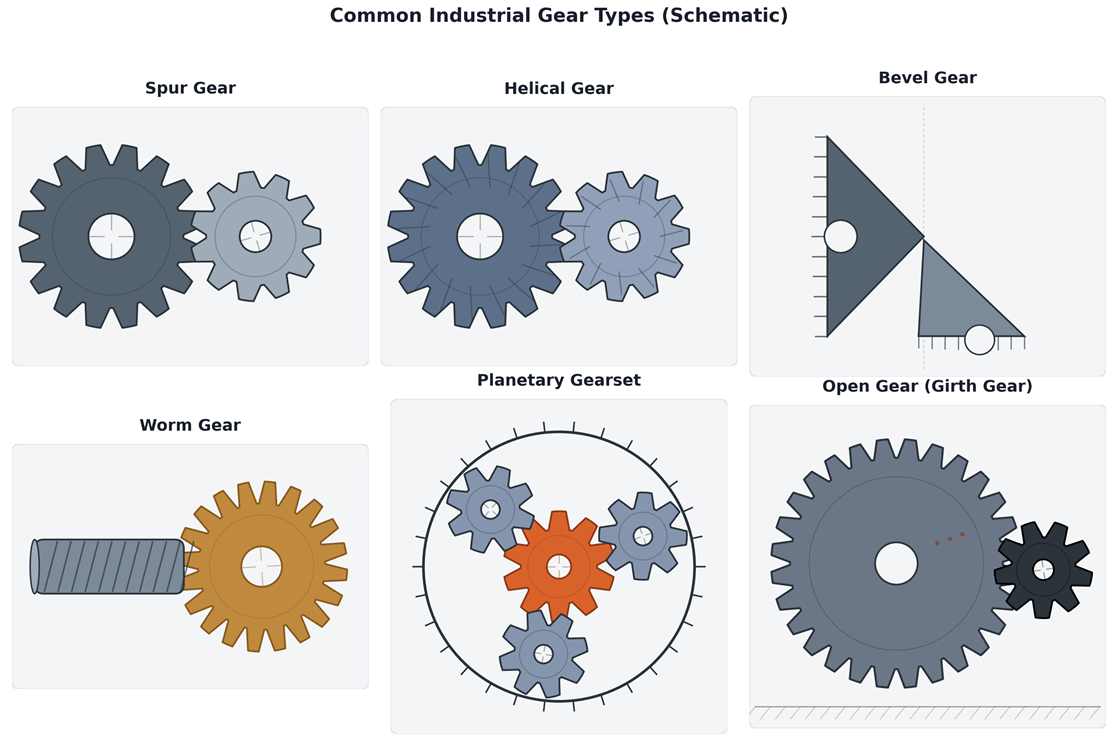
Spur & Helical (parallel shaft) |
Standard mineral or PAO EP gear oils; ISO VG 150–460 common |
|
Bevel & Hypoid gears |
High sliding contact requires strong EP additive packages (sulfur-phosphorus chemistry); often mineral or PAO with GL-5 equivalent additive treatment |
|
Worm gears |
High sliding friction against bronze worm wheels; PAG-based oils are often preferred for highly loaded worm gears because of their excellent friction reduction and efficiency benefits, although compounded mineral oils remain widely used in many industrial applications |
|
Planetary gearboxes |
Often synthetic (PAO) for compact, high-load, high-temperature service in wind turbines, mining, and mixers |
|
Open gears |
Heavy, tacky, often bituminous or asphaltic compounds designed to cling to exposed gear faces (kiln drives, large mill gears) — see dedicated section below |
Open Gear Systems in Detail
Open gears are large, slow-turning gear sets that run without an enclosed, oil-filled housing — the gear teeth are physically exposed to the surrounding environment, with lubricant applied directly onto the tooth surface rather than circulated in a sealed sump. They are common wherever a very large diameter, very high torque drive is needed at low speed: rotary kiln and dryer drives (cement, lime), large ball and SAG mill ring/girth gears in mining and mineral processing, and some large slewing or trunnion drives.
Why open gears need a fundamentally different lubricant approach
- No sump, no recirculation. In an enclosed gearbox, oil is splashed or pumped continuously and shed heat, water, and contaminants are managed by the sump volume and any filtration/cooling system. An open gear has none of this — the lubricant film applied to the tooth face is a one-time (or intermittently reapplied) coating that must survive dust, rain, temperature swings, and direct UV/weather exposure until the next application cycle.
- Very low pitch-line velocity, very high tooth load. Kiln and mill girth gears often turn at only a few RPM but transmit enormous torque, meaning the lubricant film sees extremely high unit loading for long dwell times at each contact point — closer to a boundary-lubrication regime than the hydrodynamic film an enclosed high-speed gear can rely on.
- Must resist “fling-off” and drainage. A conventional fluid gear oil, even a very heavy ISO VG 680, would simply run or sling off an exposed, rotating tooth face long before the next lubrication cycle. Open gear lubricants are therefore formulated to be tacky and adhesive, not just viscous.
Open Gear Lubricant Performance Requirements
Because open gears operate without an enclosed sump, the lubricant film has to satisfy several performance requirements simultaneously — far more than a standard circulating gear oil:
- Adhesion: must cling firmly to the tooth surface through rotation, vibration, and weather exposure rather than draining or slinging off.
- Extreme pressure (EP) protection: must carry very high unit loads at low speed, largely under boundary lubrication conditions.
- Water resistance: must resist washout from rain, washdown, or humid process environments without losing film integrity.
- Sprayability: must flow well enough through automatic spray nozzles for consistent, metered application, despite being formulated tacky and heavy-bodied.
- Low-temperature pumpability: must remain pumpable and sprayable in cold ambient conditions without clogging supply lines.
- Resistance to abrasive contamination: must tolerate dust and process material embedding into the film without rapidly degrading into an abrasive paste.
Typical formulation
Open gear lubricants are usually one of two general types:
- Asphaltic/bituminous compounds: heavy residual asphaltic base material, sometimes cut with a solvent (naphtha or similar) to allow spray application; the solvent then flashes off after application, leaving a thick, tenacious black film on the tooth surface. These have been an industry standard for large kiln and mill drives for decades because of their exceptional adherence and load-carrying capacity.
- Synthetic tacky gear compounds: modern polymer-thickened synthetic formulations (often bentonite/polymer or synthetic tackifier systems) that avoid solvent emissions and offer more consistent low-temperature application and often better environmental profiles than traditional asphaltic products, at higher cost.
Both types are typically loaded with heavy EP additive treatment (often including solid additives such as graphite or molybdenum disulfide) because the boundary lubrication regime at the tooth contact demands a strong sacrificial film independent of hydrodynamic effects.
Application methods
Open gears are almost always lubricated by automatic intermittent spray lubrication systems rather than manual application on any drive of meaningful size — a metered pump periodically sprays a measured shot of lubricant onto the pinion just ahead of mesh, timed to coat the tooth face before it engages the girth gear. Manual brush or ladle application still exists on smaller or older open gear sets but is increasingly rare on critical, large-diameter drives because of the difficulty of achieving consistent coverage and the safety risk of manual application on a live rotating gear.
Key operational and maintenance considerations
- Overapplication and underapplication are both problems. Too little lubricant leaves the boundary film unable to survive the load, leading to scuffing and accelerated wear; too much causes excess buildup, sling-off contamination of surrounding equipment and structures, fire risk (for solvent-cut asphaltic products), and unnecessary consumption/cost.
- Housekeeping and contamination. Because the gear is exposed, dust, dirt, and abrasive process material (especially in cement/mining environments) readily embeds in the tacky film, turning the lubricant into a grinding paste if application rates, cleaning, and monitoring aren’t well controlled — this is one of the most common causes of premature open gear wear in practice.
- Alignment and inspection dependency. Because there’s no enclosed sump to mask minor misalignment the way splash lubrication can, open gear lubrication performance is much more sensitive to correct gear alignment and backlash, and visual/thermographic inspection of the tooth contact pattern is a standard part of ongoing condition monitoring.
- Environmental and regulatory exposure. Being open to the environment, spray, drip, and overspray losses of open gear lubricant are a direct environmental release pathway, which is pushing continued development of biodegradable/lower-toxicity open gear compounds, particularly in mining operations with strict site environmental controls.
By Additive Package
- R&O (Rust & Oxidation inhibited) oils: Base mineral or synthetic oil with rust and oxidation inhibitors only — suitable for lightly loaded gearing.
- EP (Extreme Pressure) gear oils: R&O base plus sulfur-phosphorus EP additives — the industrial standard for most enclosed gear drives (e.g., AGMA EP grades).
- Compounded gear oils: Mineral oil blended with 3–10% fatty oil (often synthetic fatty esters replacing older animal-derived acids) — historically important for worm gear “oiliness,” still specified for some older worm-gear equipment.
4. Key Formulation Differences Explained
Viscosity and the ISO VG System
Industrial gear oils are classified by ISO Viscosity Grade (ISO VG 68 through ISO VG 680 are common for enclosed gear drives), based on kinematic viscosity at 40°C. Selecting the correct grade — influenced by ambient temperature, gear type, pitch-line velocity, and load — is often more critical to gearbox life than the choice between mineral and synthetic base stock.
Why So Many ISO Grades Exist
There is no single “correct” gear oil viscosity because gearboxes operate across an enormous range of mechanical conditions, and film thickness (the single most important factor in preventing metal-to-metal contact) is directly tied to viscosity. Multiple grades exist to match oil viscosity to each combination of the following variables:
- Load and contact pressure. Heavily loaded gears squeeze the oil film harder at the point of tooth contact. A thicker (higher-viscosity) oil is needed to maintain an adequate film thickness under high loads, while a lighter oil would be forced out, allowing metal-to-metal contact and wear. Lightly loaded gearing, by contrast, doesn’t need — and shouldn’t use — an unnecessarily thick oil.
- Speed (pitch-line velocity). At high gear speeds, the oil film has less time to be squeezed out of the contact zone, so a hydrodynamic film can form and hold with a lower viscosity oil. At low speeds, there isn’t enough relative motion to build a strong hydrodynamic film, so a higher-viscosity oil (and often EP additives) is needed to compensate through boundary/mixed lubrication. This is why high-speed turbine-type gearing often runs lighter oils than slow-turning mill or kiln drives, even though the mill drive may be far larger.
- Operating temperature. Viscosity drops as temperature rises. A gearbox that runs hot (due to high loads, poor cooling, or high ambient temperatures) needs a higher base viscosity grade so that, once thinned by heat, it still maintains an adequate film at operating temperature. Conversely, equipment starting in cold climates needs a grade that isn’t so thick at start-up that it can’t reach and lubricate all contact points before damage occurs.
- Gear type and sliding contact. Worm gears and hypoid gears, which have high sliding components, generate more frictional heat and often call for different (frequently higher) viscosity selections than parallel-shaft spur or helical gears of similar size, to compensate for the more severe lubrication regime.
- Manufacturer specification. Gearbox OEMs publish viscosity recommendations based on internal clearances, bearing types, and design tolerances specific to that unit — two gearboxes of similar size and load from different manufacturers can call for different ISO grades because of design differences alone.
In short, the ISO VG range exists because “thicker is safer” and “thinner is more efficient” are both true only within limits — the correct grade is the minimum viscosity that still maintains a protective film under the specific load, speed, and temperature conditions of that gearbox. Under-grading risks film breakdown and wear; over-grading wastes energy through unnecessary churning losses and can starve fast-moving or cold-start components of oil flow.
ISO VG Grade Guide by Gear System
The table below maps the common ISO VG grades used for enclosed industrial gearboxes to their typical AGMA equivalents and the gear systems they’re generally matched to. These are general industry starting points, not a substitute for the specific OEM nameplate/manual recommendation, which always governs.
|
ISO VG |
AGMA Equivalent |
Typical Gear System / Application |
|
32–46 |
AGMA 0–1 |
High-speed, lightly loaded enclosed gearing; small precision gear units; cold-climate or fast-turning drives where low churning loss and quick cold-start flow matter most |
|
68 |
AGMA 2 |
General-purpose enclosed spur/helical gearboxes at moderate speed and load; a common “default” grade for light-to-medium industrial gear drives |
|
100 |
AGMA 3 |
Medium-duty enclosed industrial gear units — conveyors, fans, general-purpose speed reducers running at moderate speed and load |
|
150 |
AGMA 4 |
Moderately-to-heavily loaded enclosed gearboxes; common for medium-size speed reducers on pumps, mixers, and material handling equipment |
|
220 |
AGMA 5 |
One of the most widely specified industrial gear oil grades; heavy-duty enclosed spur, helical, and bevel gear drives — mixers, extruders, crushers, medium-speed mill and kiln auxiliary drives |
|
320 |
AGMA 6 |
Severe-duty, slower-speed, higher-load enclosed gear drives; large speed reducers on heavy material handling, mining, and process equipment |
|
460 |
AGMA 7 |
Extreme-pressure, low-speed, high-torque enclosed gearing — large mill drives, heavy crushers, and high-reduction gear trains; also a common grade for compounded worm gear oil in moderately loaded worm drives |
|
680 |
AGMA 8 |
The most demanding enclosed industrial gear drives — very slow-speed, very high-load units such as large kiln, mill, and mining gearboxes; also used for slow-speed, heavily loaded worm gear drives (as compounded oil) |
|
1000+ |
AGMA 8A / beyond |
Not a standard circulating gear oil range; included here only for reference — open and semi-open gear applications above this range are typically served by tacky/adhesive open-gear compounds rather than pumpable ISO VG oils (see note below) |
Worm gear note: Worm drives generally run one grade heavier than a spur/helical unit of similar size and load, because the sliding contact between the bronze worm wheel and steel worm generates more heat and needs a thicker film to compensate. ISO VG 220 to 460 “Compounded” gear oils (containing 3–10% fatty/synthetic-ester additive rather than sulfur-phosphorus EP chemistry) are the standard choice for most enclosed industrial worm gearboxes, moving up to VG 680 for slow-speed, heavily loaded worm drives.
Open gear note: Open gears (kiln drives, large ball mill ring gears) fall outside the standard ISO VG circulating-oil range entirely — these typically use heavy, tacky, often bituminous/asphaltic compounds specifically designed to cling to an exposed gear face rather than a pumpable ISO VG oil. ISO VG 1000+ grades are generally not standard circulating gear oils; open gear compounds often have apparent viscosities far beyond ISO VG classification and are usually classified instead by NLGI consistency/penetration grade and application performance criteria, not by ISO VG alone.
EP Additive Chemistry: Sulfur-Phosphorus vs. Alternatives
Traditional EP gear oils rely on sulfur-phosphorus (S-P) additive chemistry, which reacts with nascent metal surfaces under extreme pressure to form iron sulfide/phosphide films that prevent welding. Drawbacks include potential corrosivity to yellow metals (bronze, brass) — a real concern for worm gears — and possible incompatibility with certain seal elastomers at high concentrations. Some modern formulations use ashless (metal-free) EP additives to reduce yellow-metal corrosion risk and improve environmental compatibility.
Mineral vs. PAO Synthetic: The Core Trade-off
|
Property |
Mineral Oil |
PAO Synthetic |
|
Cost |
Lower |
2–4x higher |
|
Oxidation stability |
Moderate |
Excellent |
|
Viscosity Index (VI) |
90–100 typical |
130–150+ typical |
|
Low-temp fluidity |
Poor below -10°C |
Excellent to -40°C |
|
Service life / drain interval |
Shorter |
Often 2–4x longer |
|
Seal compatibility |
Generally excellent |
Can require seal verification |
The economic case for synthetics is usually made on extended oil life, reduced energy consumption (lower friction), and reduced downtime in demanding applications — even though the upfront cost per liter is significantly higher.
PAG’s Special Case and Restrictions
PAG-based gear oils deliver outstanding friction reduction in worm gearing, but they carry more usage restrictions than any other common gear oil chemistry. These restrictions stem directly from PAG’s molecular structure (polyalkylene glycol — a polyether), which behaves very differently from hydrocarbon-based mineral oils and PAOs:
- Immiscibility with mineral oil and PAO. PAG is polar; mineral oil and PAO are non-polar hydrocarbons. Mixed together, they can separate into distinct layers or form a hazy, unstable blend that loses lubricating performance. Even small residual contamination (a few percent) left over from an incomplete oil change can compromise the new fill. A gearbox switching to PAG must be drained, and ideally flushed and wiped/cleaned of visible residue, not just drained and refilled.
- Seal and paint compatibility. PAG can soften, swell, or attack certain elastomers (notably some nitrile/Buna-N compounds) and many conventional paints and coatings used inside gearbox housings. Seals rated for mineral oil service are not automatically suitable for PAG; compatibility must be confirmed against the seal manufacturer’s chemical resistance data before conversion, or seal failure and leakage can follow within months.
- No universal PAG-to-PAG compatibility either. Different PAG products (water-soluble vs. water-insoluble grades, or different molecular weight/monomer ratios) are not necessarily compatible with each other. Switching between PAG brands or grades should not be assumed safe without checking the specific formulations.
- Aluminum and light-metal alloy components. PAGs are generally neutral toward ferrous metals and most non-ferrous metals, but aluminum and magnesium alloys are a specific exception. Several major synthetic gear oil suppliers explicitly advise against or caution on PAG use where aluminum or aluminum-alloy parts are present in a loaded, dynamic contact — for example, aluminum bearing cages or aluminum-bronze worm gear components — because increased wear can result under sliding movement and high load. In gearboxes or housings with aluminum end covers, aluminum bushings, or aluminum-bronze worm wheels, compatibility testing is strongly recommended before committing to a PAG conversion — this is a separate issue from the seal/paint compatibility problem above and is often overlooked because “PAG is fine with metals” is a common but incomplete generalization; it holds for steel and most bronze/brass, but not reliably for aluminum-containing components.
- Density and disposal considerations. Water-soluble PAGs mix readily with water, which affects both spill handling and used-oil disposal/recycling routes — used PAG oil generally cannot be co-mingled with used mineral or synthetic hydrocarbon oil in standard recycling streams.
- Limited additive interchangeability. Because PAG’s polarity affects how EP, anti-wear, and anti-foam additives behave in solution, gear oil additive packages are formulated specifically for PAG base stocks; mineral/PAO additive packages cannot simply be dosed into a PAG oil to boost performance.
Practical implication: a PAG conversion (very common when upgrading worm gear drives for efficiency) is a deliberate, planned maintenance event — drain, flush, verify seal compatibility, refill, and label the equipment clearly to prevent future accidental mixing with mineral/PAO top-up oil. This is one of the most common causes of field lubrication failures when maintenance technicians top up a converted gearbox with whatever gear oil is on the shelf.
Anti-foam, Demulsifiers, and Rust Inhibitors
Beyond EP performance, formulation quality is heavily influenced by secondary additives:
- Anti-foam agents prevent aeration-related film breakdown in high-speed or splash-lubricated systems.
- Demulsifiers allow the oil to shed water quickly rather than emulsifying it — critical in humid or washdown environments.
- Rust and corrosion inhibitors protect internal surfaces during shutdown periods, particularly important for seasonal or standby equipment.
5. Selecting the Right Gear Lubricant
In practice, gear lubricant selection comes down to matching base oil and additive chemistry to:
- Gear geometry (parallel shaft vs. hypoid vs. worm)
- Load severity (shock loading requires stronger EP treatment)
- Operating temperature range (ambient and sump temperature)
- Sliding-to-rolling ratio (higher sliding demands stronger EP or PAG chemistry)
- Environmental and regulatory constraints (biodegradability requirements)
- Total cost of ownership, not just purchase price — synthetic oils often win on lifecycle economics despite higher upfront cost
6. Industrial Gear Lubricant Standards and Classifications
Beyond ISO VG and AGMA viscosity grades, several formal standards define minimum performance requirements for industrial gear oils. These are useful reference points when writing a specification or comparing supplier data sheets:
- ISO VG (ISO 3448): Classifies lubricant viscosity at 40°C into standard grades; the universal starting point for matching an oil to a gearbox, described in detail in Section 4.
- DIN 51517-3 (CLP): A widely referenced German standard defining performance requirements for EP industrial gear oils, including oxidation stability, corrosion protection, and anti-wear/EP properties — “CLP” designates mineral or synthetic gear oils with EP additives meeting this standard.
- AGMA 9005: The American Gear Manufacturers Association standard covering industrial gear lubricant selection, including viscosity grade recommendations by gear type, speed, and load, alongside guidance on synthetic and EP oil use.
- ISO 12925-1: The international standard specifying requirements for lubricants used in enclosed industrial gear systems, broadly paralleling DIN 51517-3 CLP and often referenced alongside it in global specifications.
For most industrial buyers, matching the correct ISO VG grade with an EP additive package meeting DIN 51517-3 CLP or ISO 12925-1 covers the great majority of enclosed gearbox applications; AGMA 9005 is the standard most commonly referenced on North American and Australian OEM nameplates.
7. Applications of Gear Oils
Gear oils show up wherever rotating power has to be transmitted through meshing teeth, which makes their application range extremely broad — from a small kitchen mixer gearbox to a multi-metre kiln girth gear.
Common Industrial Gear Lubricant Applications
- Mining gearboxes
- Cement mill drives
- Steel processing equipment
- Wind turbine gearboxes
- Conveyor systems
- Crushers
- Extruders
- Food processing gear drives
- Marine gear systems
The sections below break these down by industry in more detail.
Heavy Industrial & Manufacturing
- Conveyors, mixers, and material handling drives: General-purpose enclosed EP gear oils, typically ISO VG 150–320, are the workhorse choice across factories, warehouses, and process plants.
- Crushers, extruders, and speed reducers: Higher load, often shock-loaded service calling for ISO VG 220–460 EP oils, sometimes synthetic where duty cycles are severe or continuous.
- Steel, rolling mills, and metal processing: Very heavy, often high-temperature gear drives; frequently specified with high-viscosity EP or synthetic gear oils and, on exposed mill stands, open gear compounds.
Mining & Mineral Processing
- SAG and ball mill girth gears: Classic open gear application — large, slow-turning, heavily loaded girth gears lubricated with tacky asphaltic or synthetic open gear compounds via automatic spray systems.
- Enclosed mill and conveyor gearboxes: Heavy-duty EP or synthetic PAO gear oils (ISO VG 320–680) selected for continuous, high-load, often dusty and high-temperature operation.
Cement & Lime
- Rotary kiln drives: The signature open gear application — large exposed girth gears running at very low speed under high torque, almost always lubricated with asphaltic or synthetic tacky compounds.
- Auxiliary enclosed drives: Fans, crushers, and material handling gearboxes around the kiln typically run standard industrial EP gear oils matched to load and ambient/process heat.
Wind Energy
- Main gearboxes: Compact, high-load planetary gear trains operating across a wide temperature range and demanding long, often multi-year oil-drain intervals — synthetic PAO or PAG gear oils dominate this segment because of their oxidation stability and micropitting protection.
- Pitch and yaw drives: Smaller enclosed gear units, often specified with synthetic gear oil or grease depending on design, prioritizing cold-weather startup performance.
Marine
- Propulsion reduction gears: Large enclosed marine gearboxes between engine and propeller shaft, typically running heavy-duty EP or synthetic gear oils selected for both load capacity and long service intervals between dry-dock periods.
- Deck machinery: Winches, windlasses, and cranes use enclosed gear drives, increasingly specified with biodegradable/EAL gear oils where environmental exposure or spill risk near water is a regulatory concern.
Agriculture & Forestry
- Tractor and implement gearboxes: Often specified by OEM with dedicated multi-purpose tractor fluids or standard industrial EP gear oils depending on the specific gearbox.
- Forestry equipment: A common driver for biodegradable/EAL gear oil adoption, given direct environmental exposure risk during felling and harvesting operations.
Food & Beverage Processing
- Food-grade gear oils (NSF H1-registered): Required wherever incidental food contact is possible — conveyor drives, mixers, and packaging line gearboxes in food and beverage plants use specially formulated food-grade PAO or white-oil-based gear oils rather than standard industrial products.
Oil, Gas & Power Generation
- Compressor and pump drive gearboxes: Often high-speed, precision-built units calling for lighter ISO VG grades with excellent oxidation stability, frequently synthetic.
- Turbine auxiliary gear drives: Frequently share the same synthetic R&O/EP fluid philosophy as the broader turbine lubrication system.
Automotive & Mobile Equipment
- Differentials and manual transmissions: Governed by the API GL rating system rather than ISO VG/AGMA, typically SAE 75W–90 or similar hypoid gear oils with heavy sulfur-phosphorus EP treatment for the high-sliding hypoid contact.
- Off-highway and construction equipment final drives: Heavy-duty industrial-style gear oils, often shared with hydraulic or transmission fluid specifications depending on the equipment design.
Conclusion
The evolution of industrial gear lubricants — from tallow and whale oil, through mineral EP formulations, to today’s engineered synthetics — mirrors the broader trajectory of industrial machinery toward higher loads, higher speeds, and longer expected service life with less maintenance. Understanding the real differences between base oil chemistries and additive packages, rather than treating “gear oil” as a single commodity product, is what separates a lubricant that merely meets a viscosity spec from one that genuinely extends gearbox life and reduces total operating cost.