




Oil Evaporation and the NOACK Test
Posted by Hamid Shakouri on 19th Feb 2026
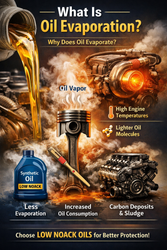
What Is Oil Evaporation and Why Does Oil Evaporate?
Engine oil isn’t just a lubricant—it’s a complex mixture of molecules that protect your engine from heat, friction, and wear. But did you know that engine oil can evaporate over time? Understanding oil evaporation is important for maintaining engine performance, saving money, and preventing damage.
What Is Oil Evaporation?
Oil evaporation is the process by which lighter oil molecules turn into vapor when exposed to heat.
Think of it like water boiling—but with oil, it happens gradually inside the engine at high temperatures.
Why Oil Evaporates?
Several factors cause oil to evaporate in your engine:
1- Temperature
-
Engine oil is exposed to high heat near piston rings, turbochargers, and exhaust valves
-
Typical oil film temperature near the piston rings: 150–300 °C
-
Turbo and exhaust areas can get hotter, but oil itself doesn’t reach 600 °C (combustion gases are that hot)
-
High heat causes lighter molecules in the oil to vaporize.
2- Oil Composition
-
Mineral oils have more light fractions → evaporate faster
-
Synthetic oils have uniform molecules → evaporate less
-
Additives can also affect volatility
3- Air Flow
-
Crankcase ventilation (PCV system) moves oil vapor away
-
This is normal, but it also increases evaporation
4-Pressure and Shear
-
Oil passes through tight clearances and high-pressure zones
-
Shear can break large molecules into smaller ones → easier evaporation
5- Oil Age and Oxidation
-
Old oil breaks down, forming smaller molecules
-
Evaporation rate increases with oil age
6- Fuel Dilution
-
Fuel mixing with oil reduces viscosity
-
Makes it easier for oil to evaporate
7- Hot Climate
-
In Australia, high summer temperatures and long drives accelerate evaporation
-
Synthetic oils perform better under these conditions
Why Oil Evaporation Matters?
Oil evaporation isn’t just a “technical detail”—it has real consequences for engine performance, efficiency, and longevity. Here’s why it matters:
1-Increased Oil Consumption
-
When oil evaporates, the engine oil level drops faster than normal.
-
Drivers notice: “My car keeps burning oil” or “I have to top up oil frequently.”
-
High evaporation oils (high NOACK) are a common hidden reason for oil loss.
Impact:
-
Frequent oil top-ups → higher running cost
-
Risk of running the engine with low oil → serious engine damage
2- Engine Deposits and Sludge
-
Evaporated oil molecules burn inside the combustion chamber.
-
This form:
• Carbon deposits on pistons
• Ring sticking → reduced compression
• Sludge inside the engine
Impact:
-
Reduced fuel efficiency
-
Harder engine start
-
Long-term engine wear and tear
3- Turbocharger Damage
-
Turbos operate at very high temperatures (250–350 °C at bearings, even hotter at the turbine).
-
Evaporated oil leaves hard carbon deposits on turbo components.
-
This can cause:
• Reduced turbo efficiency
• Bearing damage → turbo failure
Impact:
-
Expensive repairs or replacements
-
Reduced engine performance
4- Oil Thickening
-
When light molecules evaporate, remaining oil becomes thicker.
-
Thick oil:
• Flows slower → poor lubrication
• Increases friction → higher fuel consumption
• Accelerates engine wear
Impact:
-
Less efficient engine
-
Higher fuel bills
-
Shortened oil life
5- Emission System Problems
-
Oil vapors can enter the exhaust system.
-
This affects:
• Catalytic converters
• Diesel Particulate Filters (DPF)
• Exhaust Gas Recirculation (EGR) system
Impact:
-
Higher emissions
-
Possible legal compliance issues
-
Expensive emission system repairs
6- Shortened Oil Life
-
Evaporation changes oil composition.
-
Lighter fractions evaporate first → oil loses its protective qualities.
-
Additives may evaporate → oil loses detergents, dispersants, and anti-wear properties.
Impact:
-
Oil drains become shorter
-
Higher cost due to frequent oil changes
7- Fuel Economy Impact
-
Oil viscosity changes when light molecules evaporate → engine friction increases.
-
Higher friction = more fuel consumed.
Impact:
-
Even small evaporation differences can affect fuel efficiency by 1–3%, which is significant for fleets or long-distance drivers.
What Is the NOACK Test?
One key factor affecting engine health is oil evaporation, measured by the NOACK test.
he NOACK test (ASTM D5800) measures how much oil evaporates under high temperature.
How It Works:
-
Oil is heated to 250 °C
-
Air is passed over it for 60 minutes
-
Evaporated oil is measured as a percentage
Example:
-
NOACK = 8% → 8% of oil evaporated
-
NOACK = 15% → more evaporation, less stability
Lower NOACK = less evaporation = better high-temperature performance.
Why NOACK Matters?
Oil with high NOACK:
-
Burns faster → more top-ups
-
Forms carbon deposits → reduces engine life
-
Thickens remaining oil → reduces lubrication efficiency
-
Harms turbochargers and emissions systems
Oil with low NOACK:
-
Reduces oil consumption
-
Protects pistons, rings, and turbo bearings
-
Improves fuel economy
-
Lowers emissions
-
Extends oil drain intervals
Synthetic vs Mineral Oil and NOACK
| Oil Type | Typical NOACK | Performance |
|---|---|---|
| Mineral | 12–20% | Evaporates faster, shorter oil life |
| Semi-synthetic | 10–15% | Moderate stability |
| Full Synthetic | 5–10% | Excellent stability, low evaporation |
FAQ About NOACK and Oil Evaporation
Does low NOACK reduce oil consumption?
Yes – lower evaporation means less top-up oil is needed.
Can I switch from mineral to synthetic oil?
Yes, most modern engines can switch safely. Always check the manual.
Is NOACK important for trucks and industrial engines?
Absolutely. Long-haul trucks and industrial machines run hot and require stable oil.
What is a “good” NOACK number?
-
Excellent: <8%
-
Good: 8–10%
-
Acceptable: 10–12%
Understanding NOACK Limits in Engine Oils
The table above shows the maximum NOACK volatility limits for various API and ILSAC engine oil specifications. NOACK measures how much oil evaporates at high temperature, which affects engine protection, oil consumption, and turbocharger life.
Maximum NOACK Volatility by API Specification
| API Specification | Engine Type | Maximum NOACK (ASTM D5800) | Notes |
|---|---|---|---|
| API SP | Gasoline (modern) | 15 % | Standard for most passenger car oils |
| API SN | Gasoline (previous gen) | 15 % | Predecessor to SP, similar volatility limits |
| GM dexos1 Gen2 | Gasoline turbo & high-performance | 13 % | Tighter limit for OEM requirements |
| API FA‑4 | Heavy-duty diesel | 13 % | Ensures low evaporation under high temp |
| ILSAC GF‑6 | Gasoline (fuel economy) | 15 % | Also targets low oil consumption and emissions |
Summary
Oil evaporation is the process where the lighter molecules in engine oil turn into vapor under high temperatures. This is a normal phenomenon, but excessive evaporation can increase oil consumption, cause carbon deposits, thicken the remaining oil, and damage turbos and emission systems.
Oil evaporates faster due to:
-
High engine temperatures (piston rings, turbochargers)
-
Oil composition (mineral oils evaporate more than synthetic oils)
-
Shear, air flow, fuel dilution, and oil aging
The NOACK test (ASTM D5800) measures oil volatility and helps determine which oils are most stable under heat. Oils with low NOACK values evaporate less, protecting your engine, improving fuel economy, and reducing maintenance costs.
